


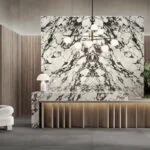
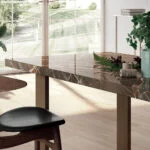


Green Marble Cippollino
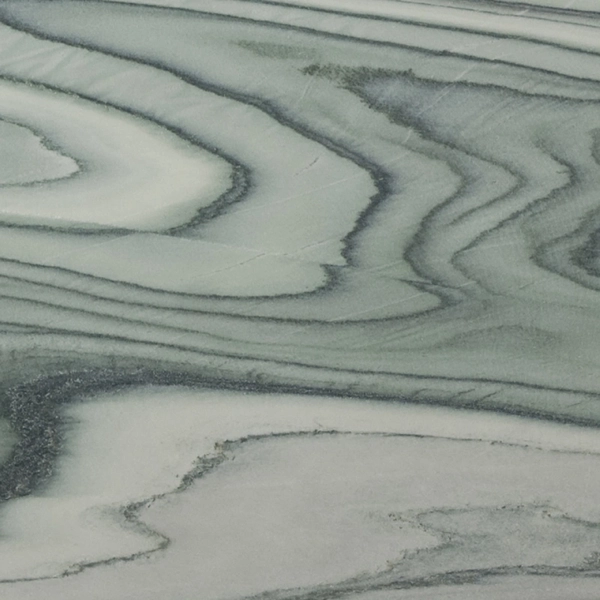
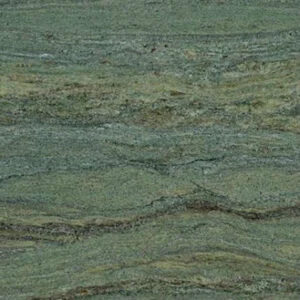
Greek green marble from Karystos of Evia, with the characteristic wavy zones of it. Known since antiquity as marmor carystium.
- Color
- Green
- Material
- Marble
What is Cippollino
Cippollino is folded limestone marble from southeastern Euboea, from the quarries between Styra and Karystos, on the slopes of Mount Ochi. The name is attributed to its concentric wavy zones, reminiscent of a cross-section of an onion. In antiquity, it was known as marmor carystium and was transported from Karystos throughout the Mediterranean.
Features
- Geological type: limestone marble with intense folding
- Origin: Karystos and Styra, Southern Euboea
- Color: green-gray with alternating wavy zones
- Cause of color: layers rich in chlorite and epidote
- Composition: calcite 83 to 93%, muscovite 2 to 5.5%, chlorite 1.5 to 5.5%, quartz 1 to 6%, albite 1 to 4%
- Historical name: marmor carystium
- Pattern: continuous parallel zones, the pattern changes significantly depending on the direction of cutting
Technical details
Published measurements from a Greek scientific publication, according to EN 12326-2. They refer to the schistose variety of the deposit, not every selection.
- Apparent density: 2.716 kg/m³
- Water absorption: 0.08%
- Open porosity: 0.20%
- Flexural strength: 24.38 MPa
- Flexural strength after freeze-thaw cycles: 18.69 MPa
- Resistance to abrasion according to Böhme: 2.54 mm
The water absorption at 0.08% is among the lowest recorded in Greek marble. It is worth noting that the flexural strength remains above 18 MPa even after repeated freezing and thawing, without visible wear on the samples.
The values refer to specific samples and not every commercial selection. For studies and external applications, request the technical data sheet of the specific batch.
Where it is used
In antiquity, it was mainly used in monolithic columns and in wall and floor cladding. The quarries came under imperial ownership in 17 AD and their operation ceased during the reign of Septimius Severus, in 206 AD. Material from Karystos can be found in the Temple of Antoninus and Faustina, in the Aemilian Basilica, in the Forums of Augustus and Trajan, in Hagia Sophia, in St. Mark's in Venice, and in Westminster Abbey.
Quarrying resumed around 1880 by an English marble merchant and continues to this day. In the modern market, the material is used in wall cladding where a strong pattern is requested, as well as in interior flooring.
What affects the price
The selection and intensity of zoning is the primary factor, as the pattern varies significantly from slab to slab. Following are the cutting direction, which determines whether the zones appear as parallel lines or as undulations, the dimensions, the finish, and the quantity of the order.
Maintenance
As limestone marble, it is sensitive to acids. Vinegar, lemon, wine, and acidic cleaners leave dullness on the polished surface. Cleaning is done with a neutral detergent and water. In outdoor spaces, the low water absorption limits damage from frost, but the unpolished finish remains preferable because the polished surface dulls over time outdoors.
Features
| Color | Green |
|---|---|
| Material | Marble |
Frequently Asked Questions
The name comes from the image of its concentric zones, which resemble a cross-section of an onion. It describes a type of design, not a specific quarry, which is why there are also in other areas.
No. Both are Greek green marbles, but they come from different deposits and have different compositions. The Cippollino owes its green to chlorite and epidote, while in the Green Tinos the composition includes serpentine.
Yes. After the Roman period the quarries remained inactive for centuries, reopened around 1880 and the extraction continues.
Information about Green Marble Cippollino
Contact us for availability, finishes, applications, and technical information.