

Green Marble of Tinos
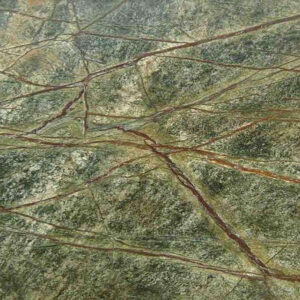
The green Marble of Tinos is kipolinis, that is, calcareous marble with layers of marbles. The green color comes from layers of marbles, epidote, and titanite in combination with iron oxides and chlorite. This layering also gives the characteristic linear pattern. Tinos and Skyros are the two Greek islands with a history in green stone.
- Color
- Green, Colored
- Origin
- Tinos
- Material
- Marble
What is the Green Marble of Tinos
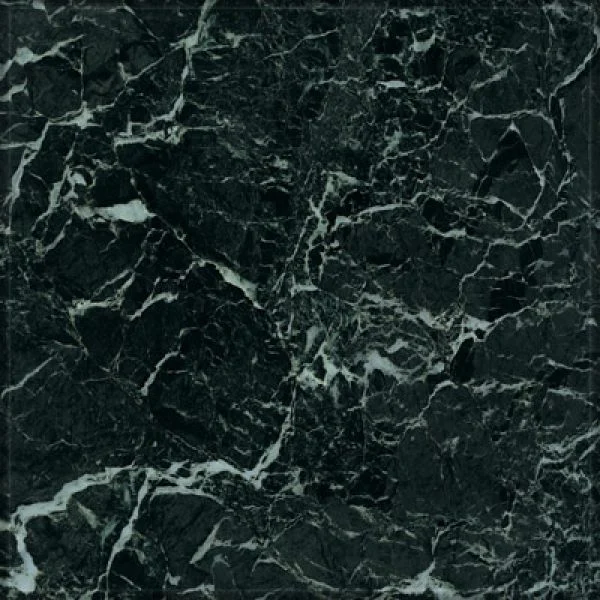
The Green Marble of Tinos is mainly extracted in the northern part of the island, in the areas of Panormos and Pyrgos, with a history of quarrying and marble sculpting that made Tinos a center of this art in Greece. It has a deep green base with white veins that cross it in irregular paths. It is one of the few Greek materials with documented international work: it was used in the building of the United Nations in New York City.
Features
- Origin: Tinos, areas of Panormos and Pyrgos
- Color: green
- Composition: serpentinite, chlorite, and limestone
- Veins: white, calcareous
- Iconic work: UN building, New York City
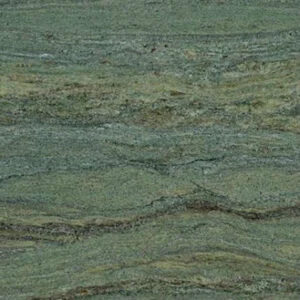
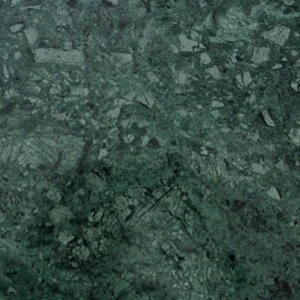
- Other greens in the catalog: Verde Rajastan, Green Forest, Green Dream, Verde Oasis
Technical details
- Apparent specific density: 2.650 kg/m³
- Water absorption coefficient: 0.05 %wt
- Compressive strength: 90 MPa
- Flexural strength: 18.03 MPa
The water absorption 0.05% is the lowest among the five Greek materials in our catalog for which published measurements exist, lower than that of Naxos (0.09%), Dionysus (0.1%), Vola (0.19-0.3%), and Thassos (0.2-0.23%). Low absorption means less tendency for stains. The measurements refer to a specific quarry and method, and are not presented as certified values of our batch.
Where it is used
In the market, it is found in wall cladding and surfaces that serve as focal points, where the intense green is justified design-wise. It is also used in decorative elements, bathroom surfaces, and fireplaces, as well as in marble sculpting items, an art with which the island is identified.
What affects the price
In Tinos, the first criterion is the intensity and uniformity of the green, which varies significantly within the same deposit and defines the selection. Following are the size of the slab and the possibility of mirror placement, thickness, cuts, and finishing, the quantity and availability of the batch.
Maintenance
The composition with serpentinite and chlorite makes the material different from calcareous marbles: the white calcareous veins react to acids while the green mass does not, so an acidic cleaner may leave a mark only on the veins and make them more visible. It is cleaned with a neutral detergent and a soft cloth. Its low water absorption helps in humid areas, but on kitchen or bathroom surfaces, the waterproofing remains useful.
Features
Similar products
Frequently Asked Questions
No, they are different deposits with a different image. However, they are among the most common confusions in the market, because both are sold as Greek green marbles. The selection is made with a sample.
Yes, on the island white materials are mined, which historically supplied the marble sculpture of Tinos. In our catalog we have the green.
The color is due to the minerals of its composition, with the serpentinite and the chlorite giving the green mass and the limestone the white veins.
The intense green with white network dominates the space. Usually, it is placed on a surface that catches the eye, and less often as a general floor.
Information about Green Marble of Tinos
Contact us for availability, finishes, applications, and technical information.