





White Marble Thassos – Extra
The white Thassos Marble is dolomitic and not calcareous, a characteristic that makes it harder and less sensitive to acids than most white marbles. It has a fine-grained, highly crystalline surface with high light reflection. The Extra indication refers to the selection, that is, the superior classification category of the slab.
- Color
- White
- Origin
- Thasos
- Material
- Marble
What is Thassos White Marble
Thassos white marble is extracted from the island of the same name in the Northern Aegean and is dolomitic, not calcareous like most Greek whites. Published analyses give a composition of 86% dolomite, 12% limestone, and 2% quartz. Extraction on the island has been recorded since the 7th century BC. The Extra designation does not refer to variety but sorting: it is the highest classification category of the slab, above A1, A2, and Commercial.
Features
- Geological type: dolomitic marble
- Origin: Thassos, Northern Aegean
- Color: white, without gray or dark veins in the Extra sorting
- Composition: dolomite 86%, limestone 12%, quartz 2%
- Texture: fine-grained, highly crystalline
- Uniqueness: high light reflection due to the crystalline structure
- Sorting: Extra, the highest category
Technical details
Published measurements from two sources. The values refer to specific quarries.
- Apparent specific gravity: 2.850 kg/m³
- Water absorption coefficient: 0.23 %wt
- Knoop hardness: 321.6 kg/mm²
- Abrasion resistance, over 1,000 m: 6.58 mm
- Flexural strength: 132 kg/cm²
From Iktinos Hellas, Saliara quarry:
- Apparent density: 2.840 kg/m³
- Absorption coefficient: 0.2 %wt
- Flexural strength: 18.5 MPa
The density close to 2.850 kg/m³ is among the highest recorded in marble. It practically means solid material with low porosity.
Where it is used
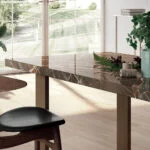
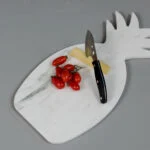
In the market, Thassos white is used in floors, wall cladding and facades, in mosaics and geometric designs, as well as in countertops and bathrooms. The hardness of dolomite makes it less sensitive to acids than calcareous marbles, a characteristic that matters in the kitchen, where vinegar and lemon are a daily reality. Suitability per application depends on the thickness and finish of the batch.
What affects the price
Sorting is the main factor, and in Thassos, the difference between Extra and lower categories is visually apparent. Following are the thickness of the slab, dimensions and cuts of the work, finish, total quantity, and availability of the batch. Since the material is largely exported, availability in a specific sorting may vary.
Maintenance
Dolomitic marble withstands acids better than calcareous, but it is not invulnerable: vinegar, lemon, and acidic cleaners leave marks with prolonged contact. Daily cleaning is done with a neutral cleaner. Waterproofing during installation, especially on countertops and bathrooms, reduces stains. In polished finish, scratches are more visible than in matte.
Features
| Color | White |
|---|---|
| Origin | Thasos |
| Material | Marble |
Similar products


Frequently Asked Questions
It is a formulation that several suppliers use, but no one publishes whiteness index or reflectance measurement to support it. What is measured and published is the composition with 86% dolomite and the density close to 2.850 kg/m³.
Beyond the pure white, in the market, versions with fine veins, with golden veins, with greenish or reddish hues are encountered. It is the same deposit with a different design, and each one is sold under its own commercial name.
Not necessarily. The historic quarry of Alyki produced gray marble, not white. Thassos has more than one deposit and the white of today's market comes from different fronts.
Information about Thassos White Marble – Extra
Contact us for availability, finishes, applications, and technical information.